
Say Hello to Subscriptions: Build Predictable Income Without Stress
Every successful coach I know has said the same thing which is that recurring revenue changed everything. This is not because it made them wealthier overnight but because it changed how they think about their business. Instead of always hunting for the next client, the next sale, the next one-off payment, they wake up knowing exactly how much money is coming in. That certainty lets you breathe. It lets you plan. It lets you actually focus on delivering great work instead of constantly selling.
One-off payments feel good in the moment. A new client signs up for a ₦50,000 coaching package and you feel the dopamine. But then it is over. And you are back to square one, hunting for the next person, the next deal. There is no room to build something that compounds. No breathing room.
Subscriptions change that equation. A coach running a weekly accountability group that charges ₦10,000 per month generates ₦120,000 per year from a single client without ever asking them again. Ten clients on a monthly subscription generates ₦1.2 million in predictable yearly revenue. And they are not even your main offering.
That is the power of recurring models. We built Subscriptions so every coach can tap into it without needing a business degree or months of setup.
What Subscriptions Actually Lets You Do
Subscriptions on Coachli lets you charge clients a recurring fee — weekly, bi-weekly, monthly, or even daily — for ongoing access to your coaching, community, content, or program. You decide the frequency. You decide how long it runs. You decide what happens if someone cancels.
Think of it as membership in the purest sense. Someone pays, they get access. They stay subscribed, they keep getting access. The billing happens automatically. The access stays active. You wake up with less admin work and more predictable revenue.
The flexibility is where the power lives. You can use subscriptions for:
- A weekly accountability group where people check in on their goals and get community support.
- A monthly membership that gives exclusive content and community access to fans or followers.
- An ongoing mentorship program where clients work with you consistently over months.
- An exclusive creator community where members get resources, private calls, and direct access to you.
- A structured learning program delivered in phases over a fixed period.
- A private forum or group where people get daily or weekly support and guidance.
Basically, any offering that benefits from repeated access, consistency, and ongoing touchpoints with your clients.
The Money Moves: Three Tiers, Multiple Price Points
Here is how the model works in practice.
You create one subscription offering. Let us say it is an accountability group. But within that subscription, you create multiple tiers. A Starter tier, a Growth tier, and an Elite tier. Each tier has its own price, its own features, and its own value proposition.
Example: Accountability Group
Starter: ₦5,000 per week
- Weekly progress check-ins
- Habit tracking template
Growth: ₦10,000 per week
- Weekly progress check-ins
- Habit tracking template
- Private community access
- Weekly group accountability call
Elite: ₦20,000 per week
- Everything in Growth, plus
- 1-on-1 monthly review session
A client chooses which tier makes sense for them. Someone just starting out picks Starter. Someone ready for more investment picks Growth or Elite. All three tiers are active simultaneously. All three are generating revenue. All three are running automatically.
This is how you capture the full range of your market in one offer. You are not leaving money on the table by offering only one price point. And you are not confusing people by offering five different products.
The economics compound fast. If you have just ten people on the Growth tier at ₦10,000 per week, that is ₦40,000 per month from that single group. If five people are on Elite at ₦20,000 per week, that is another ₦40,000 per month. All recurring. All automatic. All from one offering.
How to Set Up Subscriptions (It Is Simpler Than You Think)
The setup process is straightforward.
- Go to your offerings. Create a new subscription. Give it a name: "Accountability Group" or "Founder Mentorship" or whatever you are offering.
- Then create your tiers. For each tier, you set:
- The tier name (Starter, Growth, Elite, or whatever labels make sense).
- The price.
- The billing frequency (weekly, bi-weekly, monthly, or another interval).
- Optional: A list of features or perks included in that tier.
- Then you decide: Does this subscription run for a fixed period, like twelve weeks? Or does it run indefinitely until someone cancels?
You can set a fixed period if you are offering a cohort-based program or a structured course that lasts a specific amount of time. People pay for the duration and then the subscription ends.
Or you can set it to run indefinitely, which is perfect for memberships, communities, or ongoing coaching. People keep paying and keep getting access until they choose to cancel.
Once you save, your subscription is live. Clients can see the tiers, choose which one fits them, and subscribe. Payment happens automatically on the schedule you set. Access is managed automatically. Everything runs without manual intervention from you.
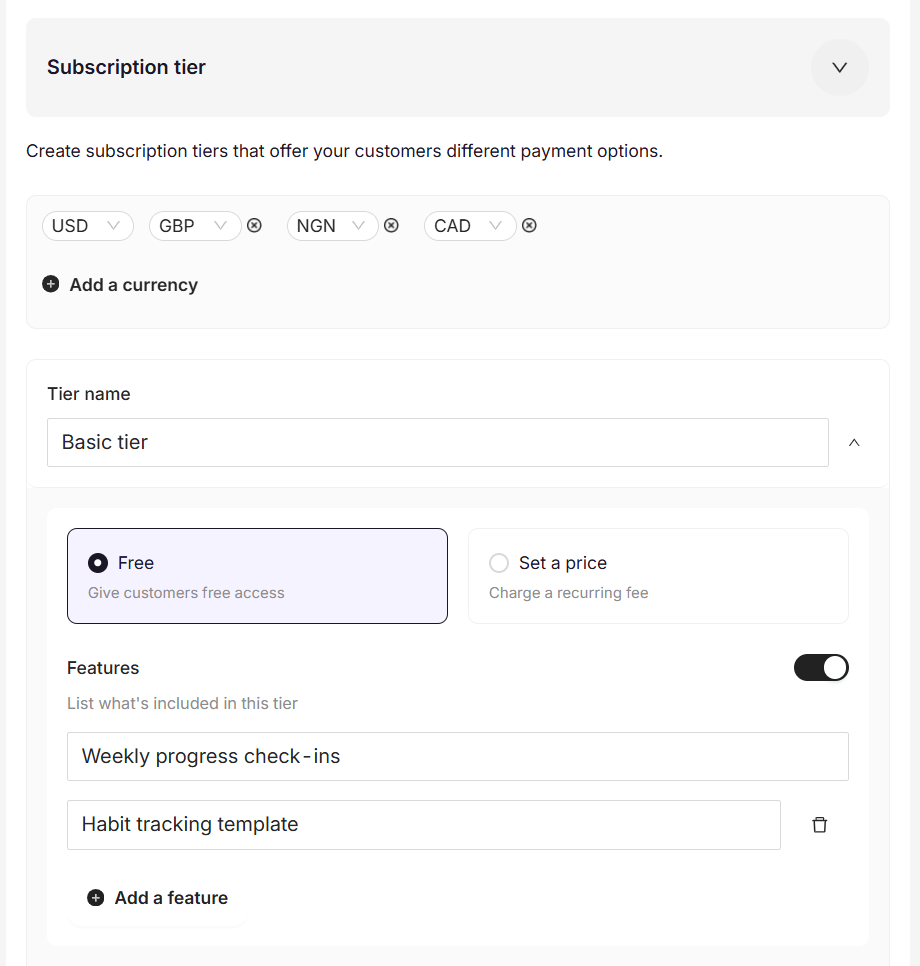
The above shows the subscription tier creation screen where coaches name their tier (e.g., "Basic tier") and choose between offering free access or setting a price. This is the first step in the setup process.
Where Subscriptions Fit In Your Coaching Business
The real power of subscriptions is how they fit different coaching models. Here are the patterns that work best.
Accountability and Community Models
These are arguably the easiest to scale. You charge a weekly or monthly fee for access to a private community, weekly check-ins, and group support. The economic unit is small enough that you can charge ₦5,000 to ₦20,000 per month and appeal to a much wider audience than your high-ticket 1-on-1 coaching.
You can run multiple cohorts simultaneously. One group on Mondays, another on Thursdays. Each person pays their subscription. All of it runs on a schedule. The weekly call happens, the community stays active, and revenue comes in every week without you constantly selling.
Creator and Membership Communities
If you have a following, a subscription membership is one of the fastest ways to monetize it. Create exclusive content — videos, templates, guides, live sessions, private Q and A. Charge a monthly fee for access. Run three tiers so that casual supporters can join at ₦3,000 per month and true fans can join at ₦15,000 per month for priority access and direct messaging.
The logistics are simple. You create content. It goes into the member portal. Members get access. You sit on the predictable monthly revenue. This is how many creators and thought leaders are now building sustainable income alongside sponsorships and partnerships.
Mentorship and Skill-Building Programs
Mentorship works beautifully on a subscription model. A UX designer charges $40, $80, or $120 per week for different levels of mentorship: portfolio reviews, design feedback, curated resources, priority support. A business coach charges $25 to $120 per month for group sessions, templates, strategy calls, depending on the tier.
What makes this work is that mentorship is inherently ongoing. People do not need one session and then they are done. They need consistent guidance over weeks and months. A subscription model perfectly aligns with how mentorship works.
Structured Learning Programs
If you are offering a skill-building program — anything from writing to design to business strategy — you can structure it as a subscription that runs for a fixed period. Eight weeks, twelve weeks, sixteen weeks. You charge weekly or bi-weekly. Clients get live training, recordings, assignments, feedback, peer access. When the period ends, the subscription expires.
The advantage here is that it feels like a program (time-bound, structured) but gets priced and billed as a subscription (recurring payments). You get both the cohesion of a course and the cash flow of a subscription.
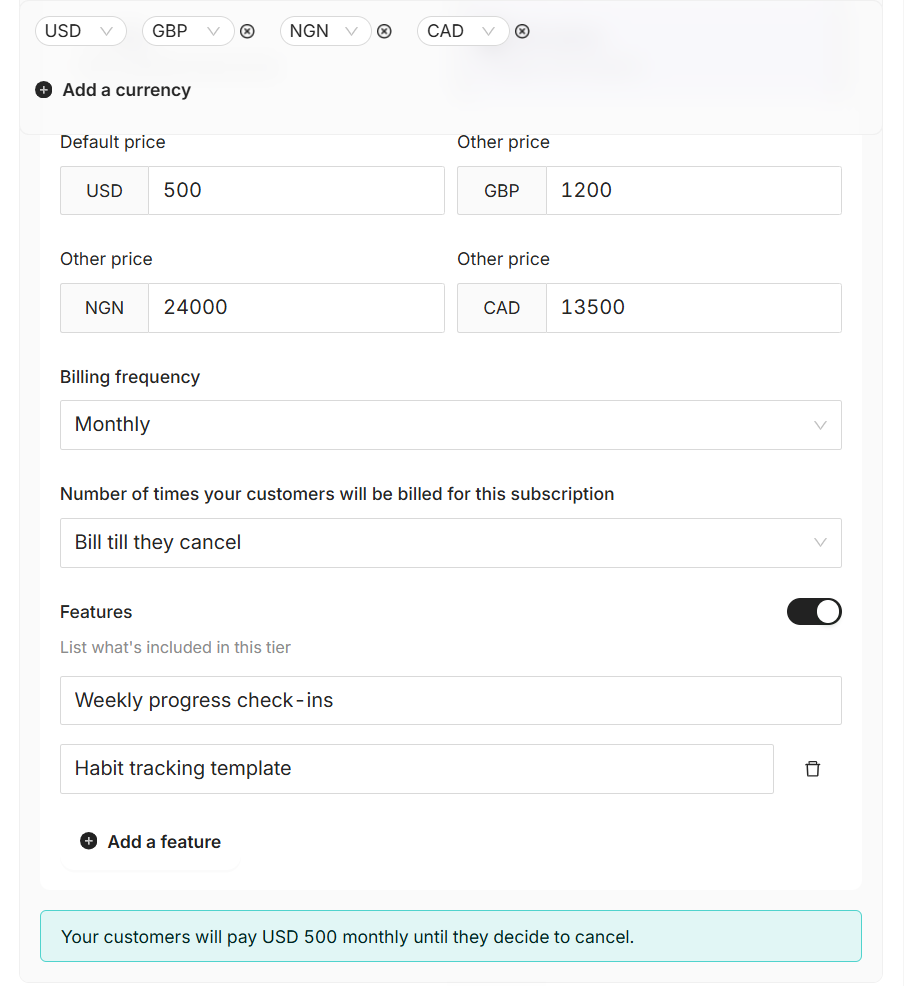
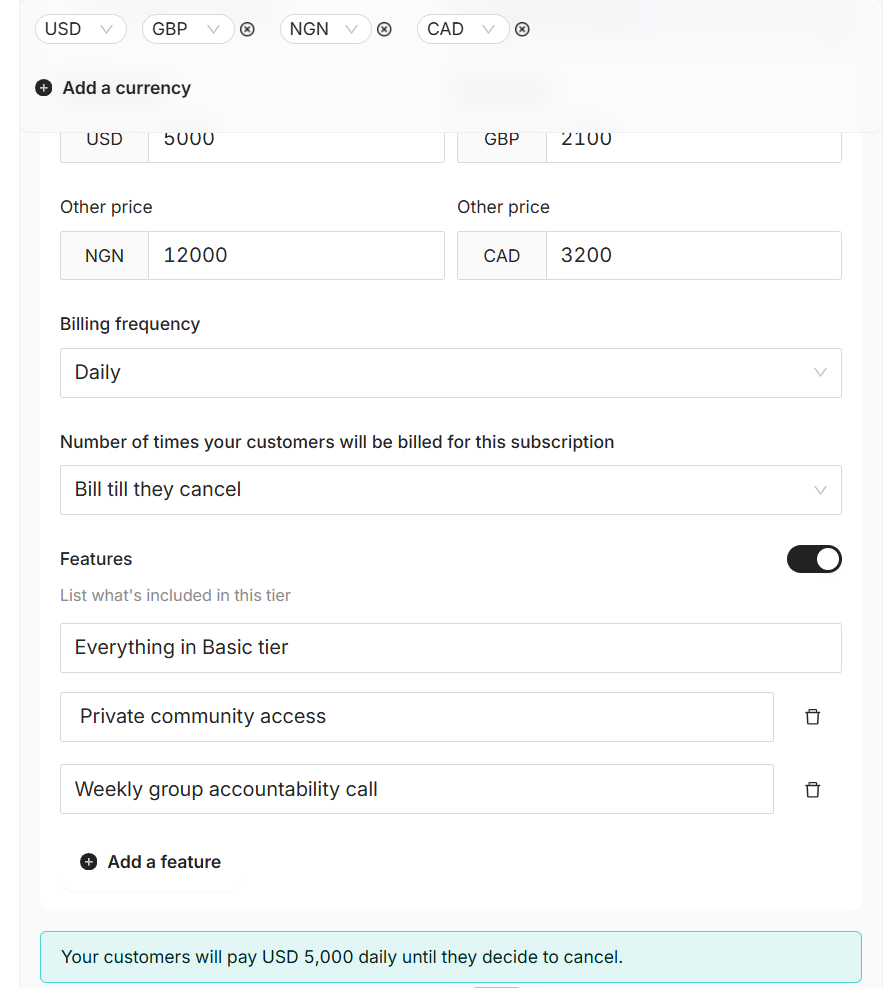
This image shows a fully configured paid tier with multiple currencies displayed (USD, GBP, NGN, CAD), the billing frequency set to "Daily," and the pricing details. This demonstrates how you set prices across different currencies and select your billing frequency.
Why This Changes How You Think About Revenue
The psychological shift is real. One-off payments are exciting for a moment. But they are also exhausting because they never stack. You are always starting from zero.
Recurring revenue is different. It compounds. It builds. It gives you space to think beyond the next month.
A coach with twenty clients on a ₦10,000 per month subscription makes ₦2 million per month. Assuming a 5 percent monthly churn rate, that is still ₦1.9 million next month, and ₦1.8 million the month after, and so on. Even with some people cancelling, you have a base. You can plan around it. You can hire support. You can invest in better offerings because you are not in survival mode.
That is not just a revenue difference. It is a freedom difference.
Real Examples: How Different Coaches Use Subscriptions
Let us walk through what this actually looks like for different types of coaches.
Example 1: The Accountability Coach
A life coach offers a weekly accountability group. Starter tier is ₦5,000 per week (₦20,000 per month). Growth tier is ₦10,000 per week (₦40,000 per month). Elite tier is ₦20,000 per week (₦80,000 per month).
She runs one accountability group per week. Everyone joins the same call, but they pay different prices based on what tier they are on. Starter members get the call. Growth members get the call plus a private community. Elite members get everything plus a monthly 1-on-1 review.
In month one, she has two people on Starter (₦40,000), six on Growth (₦240,000), and one on Elite (₦80,000). Total: ₦360,000 from one offering in month one.
Month two, she gains two more Growth members and one more Elite. Total: ₦400,000. Month three: ₦430,000. The group is growing, the revenue is growing, and she is not tripling her workload. The weekly call is the same. The community is the same. She is just charging more from people who want more access.
Example 2: The Creator with a Community
A content creator with 5,000 followers launches a membership. Supporter tier at ₦3,000 per month gets exclusive behind-the-scenes content and a monthly newsletter. Insider tier at ₦7,000 per month adds a monthly live Q and A and community access. VIP circle at ₦15,000 per month adds direct messaging and priority replies.
In month one, she has 30 supporters (₦90,000), 20 insiders (₦140,000), and 5 VIP members (₦75,000). Total: ₦305,000 from her community.
She spends four hours a month on content creation (same as she always does), one hour on the monthly Q and A, maybe thirty minutes answering DMs. That is ₦305,000 for roughly five and a half hours per month of additional work. And every month, assuming 5 percent churn, she keeps roughly 95 percent of that revenue coming in automatically while she continues creating content.
Example 3: The Mentorship Coach
A UX designer offers a mentorship program. Foundation tier is $40 per week (weekly 1-on-1 mentorship, one portfolio review). Accelerator is $80 per week (weekly 1-on-1, bi-weekly portfolio reviews, design feedback). Mastery is $120 per week (weekly 1-on-1, bi-weekly reviews, feedback, learning resources, priority support).
She takes on five mentees per cohort. One on Foundation ($160 per month), two on Accelerator ($320 per month each), two on Mastery ($480 per month each). In month one: ₦99,200 (converting at roughly 1 USD = ₦1,550).
The program runs for twelve weeks. After week twelve, everyone's subscriptions end. She has earned ₦297,600 from five mentees over twelve weeks. When the cohort ends, she opens enrollment for the next cohort and starts again.
The key insight: Her time is bounded (twelve weeks per cohort). Her revenue is predictable (same five mentees, same number paying each tier). And she can run multiple cohorts per year, so the revenue stacks across cohorts.
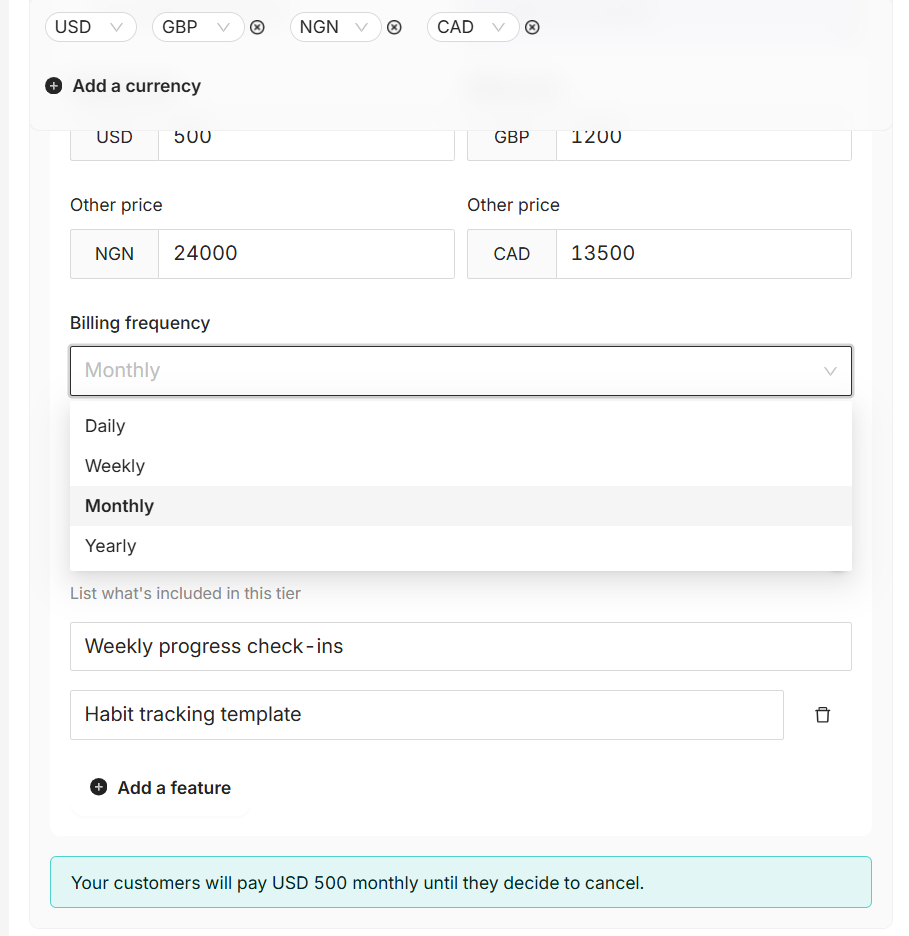
This image shows a subscription tier with monthly billing frequency selected, the "Bill till they cancel" option visible in a dropdown menu, and feature descriptions showing what is included. This demonstrates how you select whether billing is fixed-term or ongoing.
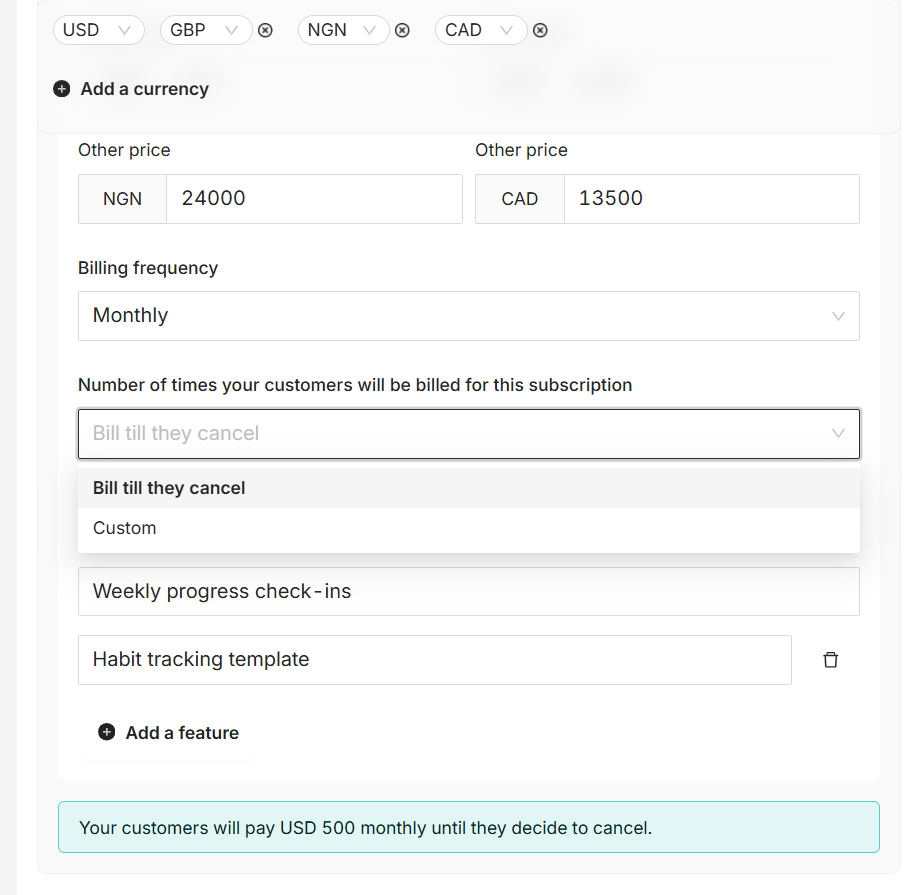
The image above displays the billing frequency dropdown menu with all available options: Daily, Weekly, Monthly, and Yearly. This shows coaches the flexibility in how often they can charge subscribers.
What Happens When Someone Cancels (Or Stays)
Subscriptions are built around the reality that some people will cancel. Not because you failed. But because their needs changed, their budget shifted, or they completed their goal.
When someone cancels, their access ends on their next billing date. They do not lose access mid-cycle. The cancellation is clean.
What matters is churn rate. If you have 100 subscribers and five cancel each month, that is a 5 percent monthly churn. If your subscriptions are ₦10,000 per month, you need to gain at least five new subscribers each month just to stay flat. Gain ten, and you are growing.
This is why the model rewards quality and consistency. If people are getting real value like real community, real feedback, real progress. This helps churn stay low while revenue grows. If people are not getting value, churn is high and you are always chasing.
This is also why the multi-tier model works. Some people cancel from the lower tier but upgrade to a higher one. Someone on Growth cancels the subscription but then buys your ₦100,000 one-on-one coaching package. The revenue does not always come from the subscription itself. It comes from the momentum the subscription built.
This image shows a complete Growth tier setup with multiple currency pricing (USD, GBP, NGN, CAD), monthly billing frequency, indefinite billing duration, and features listed (Weekly progress check-ins, Habit tracking template). This is a fully configured paid tier ready to go live.
Integrating Subscriptions With Your Other Offerings
Subscriptions do not replace one-on-one coaching, digital products, or workshops. They complement them.
A coach might offer:
- A ₦5,000-20,000 per month subscription for accountability and community
- A ₦150,000 one-on-one coaching package for people who want personalized guidance
- A ₦25,000 digital course for people who want the knowledge without the ongoing support
Some people start with the subscription. They get to know you. They see the value. Later, they upgrade to 1-on-1 coaching. That is a customer journey.
Other people buy the course first. Then they want ongoing support, so they join the subscription. Or they want deep work, so they hire you for 1-on-1 coaching.
Coachli now lets you offer all three in the same place. Clients see your subscription, your courses, your 1-on-1 bookings, and your workshops all in one storefront. You are capturing them at multiple price points and commitment levels.
The Freedom That Comes With Predictability
Building a coaching business on one-off payments is like building on sand. Revenue is lumpy. One month is great, the next is slow. You cannot hire help because you cannot promise them stable income. You cannot invest in better content or better tools because you are never sure when the next client will come.
Subscriptions change that. Fifty people on a ₦5,000 per month subscription is ₦250,000 per month. That is predictable. That is a salary. That is something you can build on.
You can hire a community manager because you know the revenue supports it. You can invest in better education content because the revenue will stick around. You can take a vacation because the subscriptions keep running while you are gone.
That freedom is not just financial. It is psychological. You stop operating from a place of scarcity. You start operating from a place of abundance.
Getting Started With Subscriptions Today
Subscriptions are live now in Coachli for all coaches and creators.
To get started, go to your offerings and create a new subscription. Give it a name. Create your tiers with pricing, billing frequency, and features. Decide if it is fixed-term or ongoing. Publish it, and that is it. You are live.
Start with one subscription if you want. Maybe a simple weekly accountability group or a monthly membership. See how it feels. See what the response is. Then expand from there.
And if you want to combine subscriptions with your one-on-one coaching, digital products, or workshops, Coachli lets you do all of that in one place.
Recurring revenue is not a nice-to-have anymore. It is how sustainable coaching businesses work. We built subscriptions to make that shift as simple as possible.
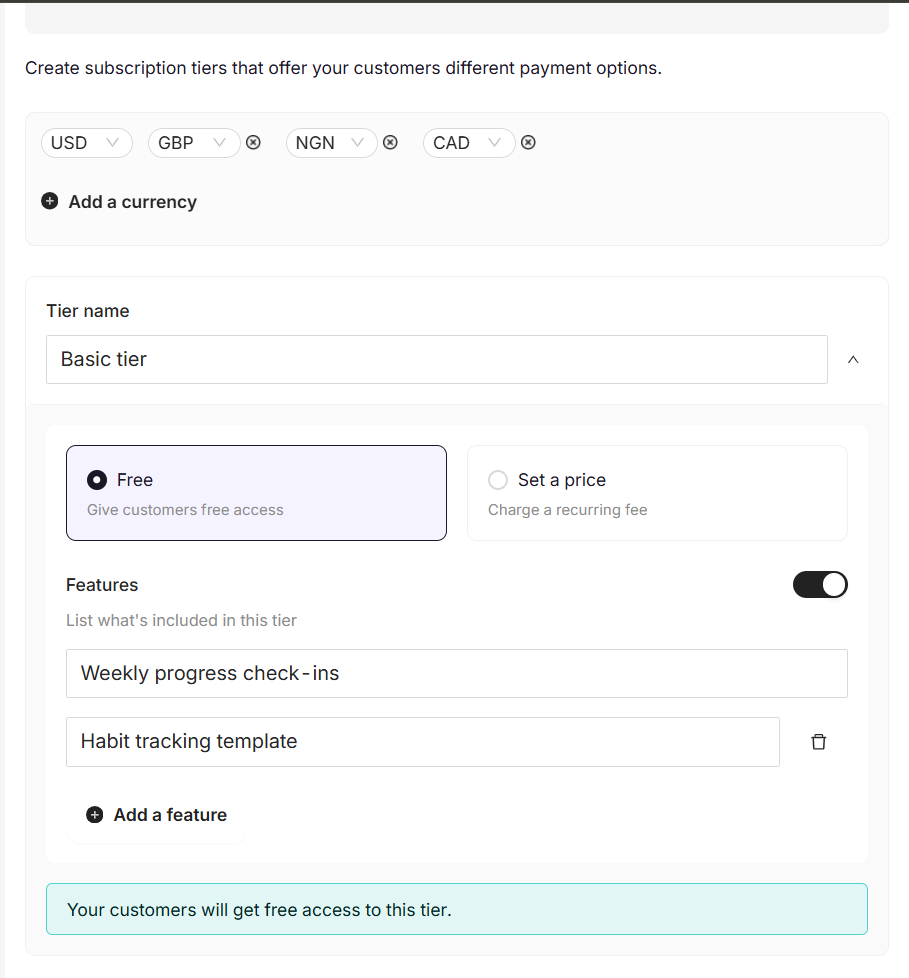
Image 6 shows the "Subscription tier" section at the top of the creation flow, with the currency selection buttons (USD, GBP, NGN, CAD), the "Add a currency" option, tier naming, and the free vs. paid pricing toggle. This is the starting point of tier creation.
Frequently Asked Questions
Can I change the price of my subscription after people have already joined?
You can create a new tier at a new price without affecting existing subscribers. Existing subscribers keep paying their original price. New subscribers see the new pricing. If you want to raise prices for everyone, you can do that too, but it will apply on their next billing cycle.
What happens if someone's payment fails?
Coachli will retry the payment. If it continues to fail after a few attempts, you get notified and the subscription pauses until the payment is resolved. You can follow up with the subscriber to fix it.
Can I offer a free trial for my subscription?
Not yet as a built-in feature, but you can manually offer trial access to select subscribers before they start paying. We are exploring free trial functionality based on feedback.
What if I want to give someone a discount or pause their subscription?
You can pause a subscription temporarily without cancelling it. You can also create discount codes or offer special pricing for specific subscribers if you want to manage those edge cases manually.
Can I combine multiple subscriptions on my storefront?
Yes. You can offer multiple different subscriptions, each with its own tiers and pricing. An accountability group subscription, a membership subscription, a mentorship subscription. Clients can choose which ones they want to subscribe to.
What currencies does the subscription feature support?
Subscriptions support Naira, USD, GBP, EUR, and other major currencies through Paystack, Flutterwave, and Stripe. You can set prices in your preferred currency.
How do I handle people who want to subscribe but pay annually instead of monthly?
You can set the billing frequency to monthly and they pay every month. If you want to incentivize annual payment, you can create a discount code or a separate tier with annual pricing that is priced lower than twelve months of monthly payments.
Can I see analytics on my subscriptions? Churn rate, revenue, etc.?
You can see subscriber counts per tier and status (active, paused, cancelled) in your Coachli dashboard. We are building more detailed analytics around churn, lifetime value, and revenue trends. For now, you have the core data to track performance.
Subscriptions are live now. If you have been thinking about building recurring revenue but didn't know where to start, this is it.
Set up your first subscription today and experience what it feels like to wake up knowing exactly how much revenue is coming in. Get started at www.coachli.co



Comments ()